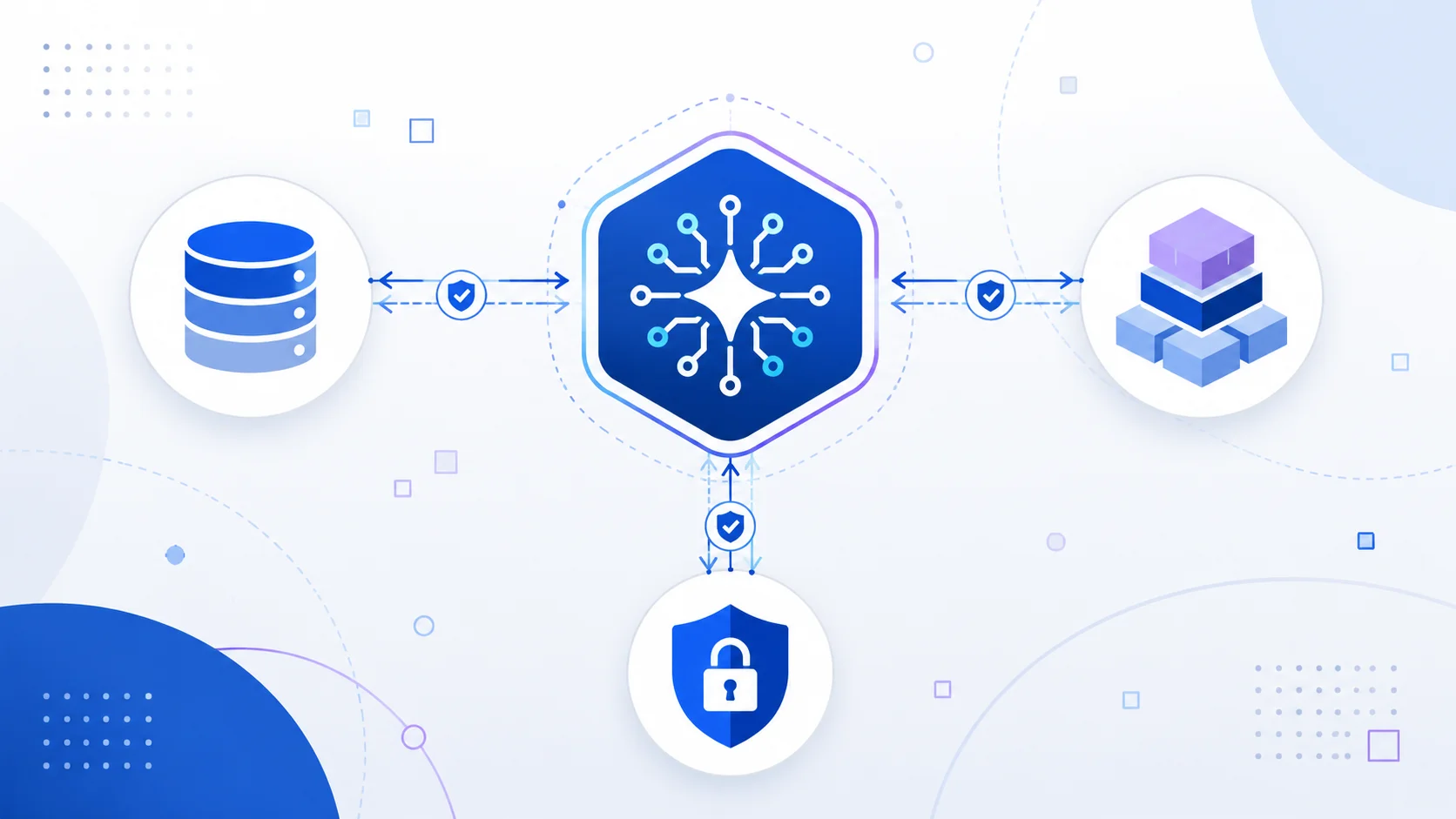
In 2026, AI adoption stops being “trying tools” and becomes “operating with AI”: governance, security, role-based adoption, and measurable outcomes. In 2027, the winners won’t be the companies that “tested AI”—but the ones that embedded it into processes with control and method.
We’re at the beginning of 2026, and that’s exactly what makes this valuable: you still have time to prepare 2026 with a clear method.
Your company has a critical decision to make now about AI adoption. Not “someday.” Now. Because what you define and execute throughout 2026—especially what you consolidate between July and December (2026)—will strongly influence whether you lead or play catch-up in 2027.
Multiple reports and studies (including academic research and industry data) argue that in Chile, millions of workers could accelerate a meaningful share of their tasks using generative AI—sometimes 30%+—and that the potential national-level value could be significant (in some estimates, a meaningful share of GDP). (Editorial suggestion: add links to the specific Stanford / CENIA / IDC / Microsoft sources you’re referencing at the end to reinforce credibility and SEO.)
This article summarizes 5 specific trends that will reshape work in Chile during 2026, focusing on real productivity, the training gap, hybrid work, emerging roles, and regulation.
Current state: Chile on the global AI map (January 2026)
Before we get into the trends, you need to understand where Chile stands today.
Enterprise adoption (based on industry reporting)
- A large share of Chilean companies have already integrated AI or are actively exploring implementation (IDC).
- Data-heavy sectors (mining, financial services, retail) show active pilots at varying levels of maturity.
Key message: Chile has a favorable context, but the gap is usually training, governance, and consistent execution—not tool availability.
Infrastructure (relevant milestones)
- Microsoft’s cloud region has been operational since 2025.
- Additional cloud investments have been announced for the coming years.
- Data center capacity expansion is projected toward 2030.
Regulatory landscape (evolving)
- The National AI Policy was updated (2024).
- Governance work has adopted international methodologies.
- An AI bill is under discussion, with a human-centered approach and risk-based frameworks.
Trend #1: 2026 as the jump toward “agentic” AI
What it is (in plain language)
Up to 2025, most enterprise AI was assistive: it helped draft, summarize, and analyze.
In 2026, interest grows in agentic AI: systems that can orchestrate tasks (with rules, validations, and human oversight) across workflows—collecting inputs, proposing decisions, executing steps, and keeping traceability.
Expected impact in Chile
In sectors with heavy administrative load and repeatable processes (finance, retail, logistics, mining administration), the outcome will look more like:
- role transformation, not “mass replacement.”
Illustrative example (finance):
- Before: a junior analyst handles repetitive steps (lookup, verification, drafting).
- With agentic AI: an agent consolidates information and proposes a recommendation; the human focuses on validation, exceptions, and judgment.
What to do in 2026 to be ready
For leaders
- Identify processes with high repetition + clear rules + available data.
- Pilot 1–2 processes with agents (traceability + human control).
- Redesign roles: what AI does, what humans do, and how quality is measured.
For teams
- Train AI supervision (validation, correction, escalation).
- Strengthen business judgment (risk, trade-offs, decision-making).
- Build “operational prompting”: clear instructions + verification checks.
Trend #2: the training gap becomes the true bottleneck
The problem
AI adoption is growing faster than formal training. Many organizations push licenses and pilots without a structured enablement program.
Typical outcome:
- inconsistent outputs,
- frustration,
- abandonment (“this doesn’t work”),
- unguided usage (risk).
Why it matters
With hands-on training, time savings and quality improve. Without it, time gets wasted on:
- poor prompting,
- excessive edits,
- rework due to inconsistent results.
Recommended training roadmap (to prepare 2026)
March–April
- Target: middle management and leadership.
- Format: practical, role-based workshops.
- Topics: prompt engineering, use cases, security basics, ROI basics.
May–June
- Target: teams with the highest email/docs/meeting load.
- Format: microlearning + exercises (15 min/day, 4 weeks).
- Topics: Word, Excel, Teams, Outlook + templates.
July–August
- Target: scale + onboarding with AI as the default.
- Outcome: reduce dependency on a few “power users.”
Trend #3: hybrid work + embedded AI becomes the permanent model
Hybrid work is no longer a transition. What changes in H2 2026 is that collaboration platforms bring AI as a native layer:
- summaries,
- meeting minutes,
- translation,
- action items,
- follow-up.
The management challenge
The question shifts from “how many hours?” to “what value was produced?” because mechanical work gets accelerated.
A sensitive topic also emerges: what to do with recovered time. If it isn’t managed explicitly, cultural tension increases.
Minimum policies to consider
- Recovered-time guidelines (training, projects, continuous improvement).
- Output-based measurement (milestones, quality, cycle time), not presence.
- Human–AI collaboration protocols: when AI is used and when human review is mandatory.
Trend #4: roles are reconfigured and governance functions expand
H2 2026 accelerates demand for profiles that connect business + AI + controls.
Roles that grow
- Role-based adoption (champions, enablement).
- Analysts focused on executive narrative (data storytelling).
- Security/governance and compliance (AI + data).
- Engineering/automation for agents and integrations.
Roles that transform (they don’t “disappear”)
- Administrative assistants → workflow coordinators and AI-controlled operations.
- Junior analysts → output supervisors + exception handling.
- Basic translators → localization and cultural context specialists.
“AI-resistant” skills that rise in value
- Empathy and leadership.
- Strategic creativity.
- Contextual judgment under ambiguity.
- Social intelligence (negotiation, influence, trust-building).
Trend #5: regulation and governance stop being “we’ll handle it later”
Chile has been developing frameworks, and in 2026 pressure increases to organize:
- what AI is used,
- for what purpose,
- with what data,
- with what controls,
- and with what traceability.
Practical implications for companies (risk-based approach)
- High risk (affects rights: credit, hiring, health): strict controls, documentation, audits.
- Medium risk (personal data, customer service): documentation and clear policies.
- Low risk (assistive productivity): best practices and reasonable controls.
Recommended preparation (throughout 2026)
Q2 (April–June)
- Inventory AI usage (tools + use cases).
- Preliminary risk classification.
- Review permissions, labeling, and DLP.
Q3–Q4 (July–December)
- Assign an AI governance owner/committee.
- Train teams on ethical and safe use.
- Create minimal documentation (what it does, what data it uses, who approves).
Case study (example format): a Chilean company preparing well
(If this is a real case, consider labeling it as “anonymized” or “internal source” for credibility.)
Profile: regional retail company (~850 employees).
Early 2026: AI limited to IT; low cross-company adoption.
2026 plan:
- Leadership pilot + measurement (time and quality).
- Gradual rollout + internal champions.
- Practical training + follow-up.
Results (example):
- Strong reduction in analysis and reporting time.
- Improved satisfaction with tools.
- 2026 focus: agentic AI for inventory and scaling to frontline teams.
Readiness checklist for your company (Q2–Q4 2026)
Q2 (April–June)
- Define what “AI adoption” means for your company (not generic).
- Choose 3 role-based use cases (sales/ops/finance/HR).
- Budget for training and support (not only licenses).
- Minimum data order: permissions, sharing, labeling.
Q3–Q4 (July–December)
- Run pilots with metrics (time, rework, 1 business KPI).
- Train frontline teams (not only leadership).
- Publish a short safe-use policy.
- Assign governance responsibilities (who decides, reviews, audits).
Tough questions worth answering (without drama)
1) What do we do with employees who don’t adopt AI?
Start with practical training + coaching + task-based goals (not “usage”). If the gap persists, evaluate role redesign aligned to the job.
2) Will AI reduce headcount?
Many organizations don’t cut immediately: they reconfigure roles, reassign work, absorb growth, and shorten cycle times. The key is an explicit, communicable policy.
3) What if we don’t adopt during 2026?
Usually not an immediate collapse—more often a gradual erosion: slower operations, higher rework costs, lower commercial velocity, and harder talent attraction/retention.
Conclusion
Recent months have been about experimentation.
2026 is the operating semester: agentic AI moving into production, formal training becoming a competitive requirement, hybrid work with AI embedded, roles reconfigured, and governance activated.
Chile has clear advantages (infrastructure, evolving frameworks, digital penetration). The risk is execution: uneven training and disorganized adoption.
The window is 2026.
Companies that execute well between July and December will enter 2027 with structural advantage. Companies that wait will enter 2027 playing...